Dishwasher Drain Pump: Function, Failure Signs and Replacement Planning
A symptom can point toward the drain pump, but the part should not be replaced until its input, output and surrounding system are checked. This guide explains the part's role and the evidence that separates it from look-alike failures.
The drain pump moves water or condensate through the designed discharge path at a specific stage. Its failure can affect the sequence, but the same symptoms can come from supply, obstruction, safety feedback or control faults.
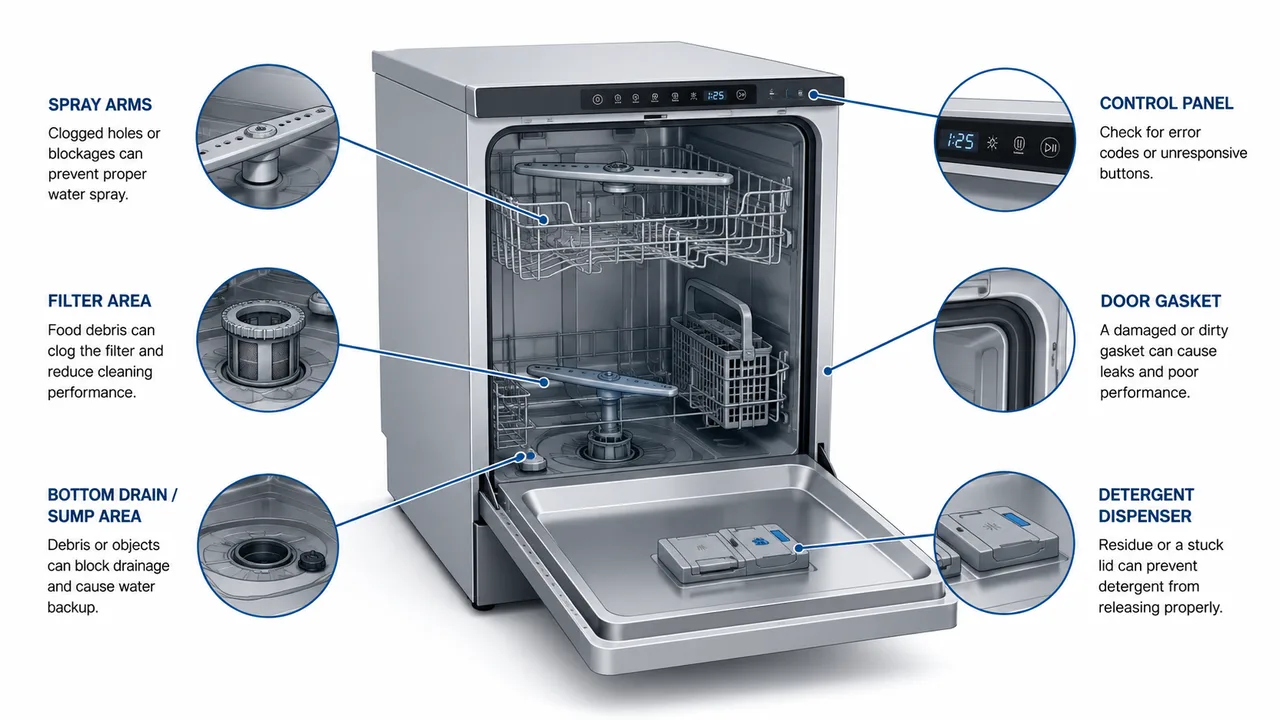
Use the illustration together with the fast answer and safe-check section so you inspect the right area before buying parts, using cleaners or calling for service.
Practical repair plan for Dishwasher Drain Pump: Function, Failure Signs and Replacement Planning
This article is organized to help a reader move from symptom to action without guessing. The goal is not to push a part replacement. The goal is to confirm the symptom, understand what the observation means, run only safe checks, contain the problem, choose the next step and know when a qualified specialist is the safer option.
Difficulty level
Understanding guide; replacement may require model-specific service. Treat the first pass as diagnosis, not repair. A repair becomes advanced when it requires live electrical testing, fuel adjustment, refrigerant work, sealed-system access, structural opening, spring tension, pressure vessels, heavy lifting or manufacturer-only calibration.
Most likely issue type
This page belongs to appliance / water and drainage. In practical terms, the most likely cause is usually one of four groups: setup or use condition, blocked input or output path, failed protection/sensor signal, or an internal component that needs model-specific testing.
Safety boundary
Stop immediately for live voltage, moving parts, hot surfaces, water near electrical components, stored energy and model-specific safety devices. A red warning sign means the correct result is not another internet step; it is making the area safe and involving the right professional.
Best first decision
Start with what changed recently. A new filter, moved appliance, recent cleaning, power outage, heavy load, construction dust, freezing weather, clogged drain, closed valve, closed vent or changed setting often explains a problem before any part has failed.
Tools and materials to gather before you start
Gathering simple items first keeps the diagnosis calm and prevents damage caused by rushing. Do not buy a replacement part until a check below points to that part or a professional confirms it.
Useful tools
- model number
- owner manual
- photos of location
- symptom notes
- repair history
Possible materials
- correct OEM or compatible part only after confirmation
- new fasteners or seals if specified
- manufacturer instructions
- returnable packaging
The diagnosis: what symptom are you actually confirming?
For Dishwasher Drain Pump: Function, Failure Signs and Replacement Planning, the symptom is the starting point, not the conclusion. A useful diagnosis separates what you directly observed from what you assume has failed. Write the observation in plain language: when it starts, how long it takes, what happened immediately before it, whether the condition is constant or intermittent, and whether anything changed after a safe external correction.
Good symptom notes include the condition of the surrounding area. Check whether the floor is wet, the cabinet is warm, the panel is unresponsive, the room smells unusual, the surface changed color, the sound occurs once or repeatedly, or the problem appears only after a heavy load or long cycle. Those details often separate a simple maintenance issue from a deeper mechanical, electrical, plumbing or structural issue.
Photograph the model tag, the affected area and any display or warning light. Photos prevent two common mistakes: ordering a part for the wrong model and describing a symptom differently each time. They also help a technician or specialist decide whether the visit needs parts, safety equipment or a different trade.
Fast step-by-step path
- Confirm the exact symptom. Write down what you see, hear and smell before touching the dishwasher.
- Make the area safe. Disconnect power before touching accessible parts, and shut off water or gas only when the appliance manual tells a homeowner to do so before touching accessible panels, water paths, filters, vents or nearby surfaces.
- Find the model number, owner manual, installation details and any recent service history.
- Check the easy external conditions first: settings, access, airflow, water flow, drainage, seals, filters, clearances, level and visible debris.
- Change only one condition at a time, then repeat a short, safe observation under the same conditions.
- Interpret the result before buying a part. If the behavior did not change, the first visible part may not be the cause.
- Contain the issue so it does not spread to flooring, cabinets, walls, wiring or stored items.
- Use the professional handoff checklist if the next step requires live voltage, gas, refrigerant, structural opening, sealed components or heavy lifting.
What each result means
Each safe check should answer a question. If clearing debris, opening airflow, correcting a setting, resetting a normal user control, drying an area or redistributing a load changes the symptom, the issue was probably not a failed major component. If nothing changes and the same stage fails again, the remaining cause is more likely inside the dishwasher or tied to a model-specific sensor, switch, valve, motor, control, drain, vent or sealed path.
| Observation | What it usually means | Safer next move |
|---|---|---|
| The dishwasher drain pump: function, failure signs and replacement planning pattern changes after cleaning or clearing access points. | The cause is more likely maintenance, blockage, airflow, water flow, loading, leveling, settings or another external condition. | Repeat one normal use, document the change and add the related prevention task. |
| The dishwasher drain pump: function, failure signs and replacement planning pattern returns at exactly the same stage. | A specific control, sensor, interlock, valve, motor, drain, vent, seal or internal path may be failing at that stage. | Stop replacing random parts and narrow the stage with model information or professional testing. |
| The symptom includes heat, smoke, odor, water near electricity, active leaking, arcing, gas smell or repeated breaker trips. | The problem has moved beyond normal homeowner troubleshooting. | Stop use, make the area safe from outside the hazard, and call the correct professional. |
| The issue only happens under high load, long run time, heavy use, hot weather or after recent work. | Load, installation, airflow, drainage, thermal protection or a changed setup may be part of the cause. | Compare with a light controlled test only if safe, and inspect recent changes first. |
The key is to avoid treating one symptom as proof of one part. A blocked outlet can make a pump sound weak. A dirty filter can make a motor or compressor look defective. A loose door, latch or seal can make a control board look confused. A protection trip can be the correct response to an unsafe condition. When the result does not clearly support a part, do not buy the part yet.
Contain the problem so it does not get worse
Containment is different from repair. Containment protects the home while you decide the next step. If water is involved, keep it away from electrical components, flooring edges, cabinets and wall cavities. If heat is involved, let the system cool and keep combustible items away. If the issue involves odor, smoke, chemical residue or suspected contamination, ventilate only when safe and avoid spreading residue through the home.
For a dishwasher, containment often means stopping use, documenting the condition, removing nearby stored items, drying only the surrounding area, placing a towel or shallow pan where it will not create a slip or electrical risk, and leaving the failed component untouched until the cause is known. Do not seal, tape, caulk, paint or cover damage before the source is identified. Cosmetic fixes can hide active moisture, heat damage or movement and make the final repair more expensive.
If the symptom is intermittent, containment also means limiting repeated tests. Repeated starts can overheat a motor, erase error history, flood a drain path, worsen a leak, trip protection devices or make a dangerous condition appear normal. Run only the minimum safe comparison needed to understand whether an external correction changed the result.
Repair options that make sense
The most reasonable repair path depends on what the safe checks prove. If the cause is access, cleaning, a clogged filter, a closed valve, blocked venting, a dirty surface, an overloaded load, a kinked hose, a loose support, a failed consumable or a missed maintenance task, the homeowner may be able to correct it with the manual open and the system safely shut down. If the cause requires measuring live voltage, opening sealed compartments, replacing internal wiring, handling refrigerant, adjusting gas combustion, lifting heavy equipment or disturbing structural materials, the safer repair is professional service.
Before approving a repair, compare three things: the confirmed fault, the age and condition of the system, and the total cost after diagnosis, labor, parts, return visit risk and collateral damage are included. A small part can become a poor repair if the surrounding system is worn, unsafe or near end of life. A more expensive repair can be reasonable when the system is newer, the diagnosis is confirmed and the failure did not damage other areas.
Do not use the article as a substitute for the model-specific manual. The page explains how to reason through Dishwasher Drain Pump: Function, Failure Signs and Replacement Planning, but manufacturers change access panels, service modes, sensors, part revisions, reset sequences and safety instructions. The model number and owner manual take priority whenever a procedure differs.
When to call a professional
Call a qualified professional when the next step requires access you cannot reach safely, when the same fault returns after simple checks, or when the observation points to electricity, gas, refrigerant, combustion, structural damage, active flooding, sewage, mold, spring tension, pressure vessels or hidden moisture. A professional is also the right call when a repair must be documented for insurance, warranty, rental property rules or resale disclosure.
Give the professional a concise handoff: the exact title-level symptom, model number, photos, what you checked, what changed, what did not change, whether the problem is intermittent, and whether any warning signs appeared. That handoff can reduce diagnostic time and help the technician arrive with the right tools or parts.
How to prevent the problem from returning
Prevention works best when it targets the actual cause. If the cause was blockage, schedule cleaning. If the cause was installation, correct the slope, clearance, connection, level or support. If the cause was loading or use pattern, change the habit that created the stress. If the cause was age, track symptoms more often and compare repair cost against replacement before failures become emergencies.
For most appliance / water and drainage topics, a monthly visual check and seasonal deeper check are enough to catch many problems early. Keep filters, vents, drains, seals, caulk lines, accessible coils, hoses, cords and shutoff points visible. Do not store items tightly around equipment that needs airflow or access. Keep photos of the normal condition so slow changes stand out. Record the date of cleaning, part replacement, filter change, service visit or water event.
After a repair, run one normal use and inspect the surrounding area again. Look for moisture, odor, heat, vibration, new noise, repeated codes or anything that changed from the baseline. A repair is not complete simply because the symptom disappeared once; it is complete when the cause is corrected and the system operates normally under expected conditions.
Related next steps
If this article is the first page you opened, use the related paths below to continue without guessing. Move from symptom to component, from component to cost, and from cost to repair-or-replace only after the safety checks are complete.
Inspect owner-accessible filters, hoses, reservoirs and discharge points with power off. Prepare for retained water. Do not reach into a pump, bypass a float or energize exposed wiring. Stop for active flooding, a burning odor, arcing, a repeated breaker trip, hot water escaping the cabinet or glass/debris obstructing a pump.
Where the drain pump fits in the operating sequence
The dishwasher depends on water fill, detergent release, circulation, spray, filtration, heating, draining, drying, door sealing and electronic cycle control. Within that chain, the drain pump moves water or condensate through the designed discharge path at a specific stage. A reliable diagnosis asks three questions: did the control request the function, did the component receive the correct input, and could the output move through the rest of the system?
That sequence matters because a good component can look failed when a door switch, float, thermostat, pressure signal or control condition prevents its command. It can also run normally while a blocked hose, vent, filter, coil, spray path or drain hides its output. Replacing the visible part without proving these boundaries creates repeat failures and unnecessary cost.
Use the full model and serial number before comparing diagrams or parts. Manufacturers change suppliers, connectors, mounting and control logic within the same product family. A component that looks identical may have different ratings or software requirements.
Signs that can support a drain pump problem
- the unit reaches the drain or transfer stage but flow is weak or absent
- a hum occurs without matching water movement
- leakage appears from the pump area or reservoir
- a float or level safety repeatedly stops operation
None of these signs proves the part by itself. Strong evidence comes from a repeatable operating stage plus confirmation that the upstream supply and downstream path are normal. For example, a pump that is powered but cannot move water through a blocked hose is not necessarily defective; a motor that never receives a valid door signal should not be condemned; and a sensor that opens during real overheating may be protecting the equipment correctly.
Problems that commonly imitate this part
- a blocked hose, filter, sump, air gap or household drain
- a stuck float or incorrect water-level signal
- a kink, frozen section or installation error
- a control that never sends the pump command
Start with the easiest reversible condition. Confirm settings, loading, filters, valves, hoses, vents, drains, clearances and recent work. Then compare behavior during one controlled test. If the symptom changes, you have evidence. If it does not, move inward one system boundary at a time instead of guessing.
Safe checks before ordering a part
- Confirm the exact model. Photograph the rating label and compare the parts diagram for that complete model, not just the brand and product name.
- Define the failed function. Record the exact cycle or operating stage, selected settings, load and environmental conditions.
- Check external requirements. Verify electrical power, hot water, correct detergent, a sound drain connection and properly loaded racks before opening the appliance.
- Inspect the downstream path. A blocked air, water, drain, exhaust or mechanical path can conceal normal component output.
- Inspect visible condition with utilities off. Look for corrosion, broken mounts, heat damage, leakage, debris and loose connectors without removing guarded or sealed assemblies.
- Stop at the measurement boundary. Live voltage, current, gas pressure, combustion, refrigerant and insulation testing require appropriate training and instruments.
What a professional test should establish
| Question | Evidence needed |
|---|---|
| Is the part receiving the correct command? | Control sequence, safety inputs, wiring continuity and the expected voltage or signal under the model's service procedure. |
| Can the part perform without obstruction? | Free mechanical movement, clear flow path, correct pressure/airflow and no downstream blockage. |
| Does it fail cold, hot or under load? | Some motors, coils, relays and electronics work once and fail as temperature or demand rises. |
| Did another fault damage it? | Moisture, poor voltage, blocked airflow, scale, overload and seized mechanisms can destroy the replacement too. |
Ask the technician to explain the failed measurement and the condition that caused it. “The code says the part” is incomplete: many codes identify a circuit or observed condition rather than a single defective component.
Replacement and quote planning
Confirm the exact pump voltage, connector, mounting, seal and flow direction. Correct the blockage or installation cause that may have overloaded the original pump. Confirm whether the part is original-equipment, manufacturer-approved substitute, aftermarket or refurbished. Ask who provides the part warranty and whether repeat labor is covered. Electronic controls may require configuration; water and gas parts need new seals and leak testing; motors and pumps may need associated wear parts; and sealed-system work requires recovery, evacuation and leak verification.
Before authorizing replacement, compare the all-in scope with equipment age, condition and repair history. Include diagnostic fee, labor, part, shipping, tax, disposal and any correction to venting, drain, supply or installation. A lower-priced part does not create value if the underlying cause remains.
Order by complete model and revision. Visual similarity, a marketplace “fits many models” statement or matching connector count is not enough for a safety-critical or electronically controlled part.
Failure prevention
- Keep the related filter, drain, vent, coil, hose or moving path clean and unrestricted.
- Use correct loads, detergent, cookware, water treatment and operating settings.
- Correct leakage, vibration and overheating early so they do not damage wiring or bearings.
- Use the specified circuit and avoid extension cords or improvised adapters.
- Record baseline cycle time, sound and temperature so gradual degradation is visible.
Common questions
Can a component pass a simple continuity test and still fail?
Yes. Some parts fail only under voltage, heat, pressure or mechanical load. Continuity alone does not prove correct performance, and live testing can be hazardous.
Should I replace the control board first when several functions fail?
No. Check supply, common safety inputs, moisture and the loads connected to the board. A shorted motor or valve can damage a new board.
Is an aftermarket part always unsafe?
Not automatically, but rating, materials, certification, connector, software and manufacturer substitution must match. Safety devices, gas controls and high-current electronics deserve particular caution.
Diagnosis, fix path and prevention
This section is written to make the page useful in the moment: identify the likely problem, run only safe checks, understand what each result means, choose the best next step and prevent the same failure from coming back.
Most likely problem
The probable problem is not automatically this part; it is whether this component is truly the weak link in the dishwasher sequence.
Safe checks before replacing parts
Confirm model number, compare the symptom with a diagnosis page and inspect only visible mounting, filters, connectors or owner-accessible areas. Also check filter, spray arms, drain loop, water supply, detergent cup, door gasket and loading pattern.
- look for a kinked hose, clogged filter, full pan or blocked discharge
- listen for pump/fan operation when water should move
- check whether water returns after discharge
What each result means
If the symptom changes after cleaning, reseating or restoring airflow/water movement, the part may be fine. If the same failure repeats with correct inputs, the component becomes a stronger suspect.
- slow movement means restriction
- humming without movement suggests jam or failed drive
- water returning points check valve, loop or outlet
Best next step
Price the part, confirm compatibility and compare part cost with labor. Expensive, buried, safety-critical or commonly misdiagnosed parts deserve professional confirmation.
When to stop
Stop and call a qualified professional for water under cabinets, burning smell, damaged cord, repeated breaker/GFCI trip, swollen flooring or wiring/control access. Also stop whenever the next step would bypass a safety control, expose live voltage, open a sealed system, disturb gas or combustion, enter a flooded electrical area or require unsafe access.
How to prevent it
Prevent recurrence by fixing the condition that caused the failure, not just the visible symptom. For this topic, the most useful habits are: clean filters, scrape heavy food, avoid blocking spray arms, use rinse aid and maintain the high loop or air gap. Recheck after the first normal use and add recurring tasks to a maintenance calendar.
Quick decision table
| Observation | What it usually means | Safer next move |
|---|---|---|
| The symptom changes after a simple external correction. | The cause was likely setup, blockage, cleaning, loading, airflow, water flow or access related. | Repeat one normal use and add the prevention task to your schedule. |
| The same stage fails again after safe checks. | The remaining cause is more likely a component, sensor, control, internal path or installation issue. | Use the related component/cost guide or request model-specific service. |
| The symptom includes a safety warning sign. | The risk is no longer a normal homeowner diagnostic problem. | Stop using the system and call the appropriate qualified professional. |
Additional practical notes for Dishwasher Drain Pump: Function, Failure Signs and Replacement Planning
Access And Visibility: When a reader arrives at this page, they are usually trying to decide whether dishwasher drain pump: function, failure signs and replacement planning is a quick maintenance issue, a repair worth attempting, or a warning sign that requires help. The safest way to answer that question is to keep the investigation visible and reversible. Visible means you can explain each observation without removing protected covers. Reversible means you can put the system back the way it was if the check does not change anything.
Common False Positives: The practical order is always evidence before action. Evidence includes the model number, the exact stage of failure, the condition of surrounding materials, the timing of the symptom and any recent changes in use, weather, cleaning, installation, power, water, drainage or load. Action comes later, after the evidence points toward a narrow group of causes.
Containment Before Cosmetic Repair: A homeowner-friendly check should not require live measurement, gas adjustment, refrigerant handling, sealed-system work, internal wiring repair or force. If the next check requires one of those things, the check itself has answered the question: the problem is no longer a normal DIY diagnosis. That conclusion is useful because it prevents damage and avoids unnecessary parts.
Quote Preparation: Prevention is also part of repair. After the immediate issue is stable, identify the condition that allowed it to develop. For a dishwasher, that condition may be blocked airflow, neglected cleaning, poor drainage, a missing clearance, a worn seal, an overloaded use pattern, water entering a material, delayed maintenance or an installation detail that has slowly moved out of tolerance.
Post-Repair Verification: The best outcome is a clear decision: correct a simple external condition, monitor with dates and photos, buy a confirmed consumable, request model-specific service, or replace the system when repair no longer makes economic or safety sense. Each of those decisions is better than guessing at the first part mentioned online.
Sources and verification
This guide uses system-level safety and maintenance principles. The exact model manual and service information take priority for access, limits and test procedures.